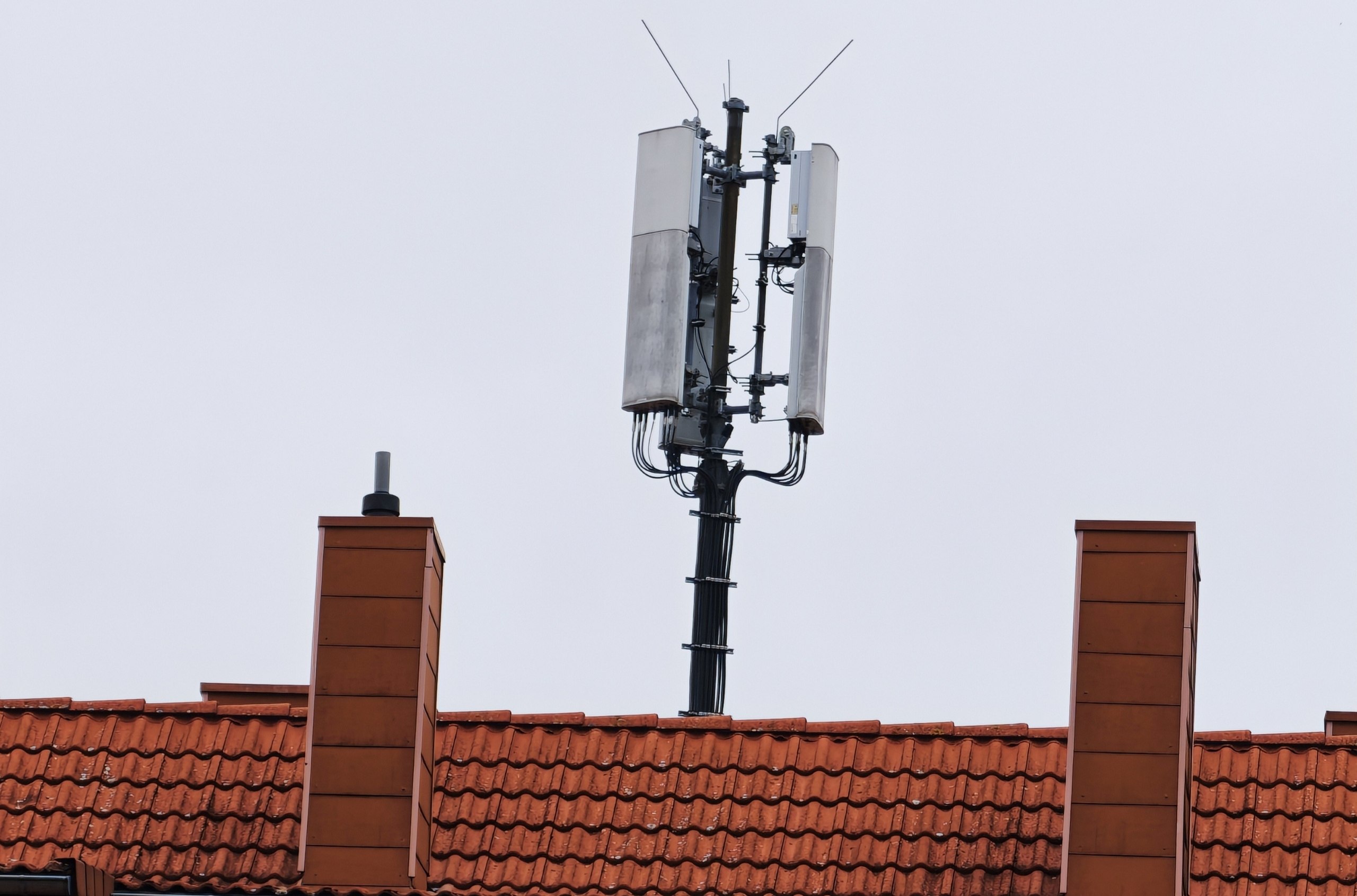
1024QAM is the highest downlink modulation that 5G NR currently offers, and until now it has been something you read about in specification documents rather than something you see on a live network. I recently got the chance to test it on Vodafone Germany’s 5G standalone network in the Huawei vendor area in Hannover, so here is what it looks like in practice.
How I tested it
The test setup was a Xiaomi 17 Ultra whose modem configuration had been modified so that 1024QAM was enabled. The modem supports the feature, but it is off by default on the device, so this was how I got it running on a live network. I tested sites near Hannover main train station, which sit in the Huawei vendor region of Vodafone’s network.
For those who have not come across it before, 1024QAM packs 10 bits into every modulated symbol instead of the 8 bits that 256QAM carries. That is a 25 percent increase in the amount of data that can be carried per resource element, and it is why the modulation matters so much for downlink capacity in good radio conditions.
Line of sight is where 1024QAM shines
In a line of sight scenario it was relatively easy to get a high 1024QAM usage percentage. The signal arrives cleanly, the SNR is high, and the handset is happy to stay on the highest modulation order.
The catch is that line of sight does not really allow signals to fade or reflect that much, which is exactly what helps a MIMO system create independent spatial layers. So even though 1024QAM was being used almost all the time, the number of usable layers was often limited to 2. With two downlink streams and 100 percent 1024QAM utilisation, the result was around 760 Mbps PHY throughput on the 80 MHz N78 carrier.
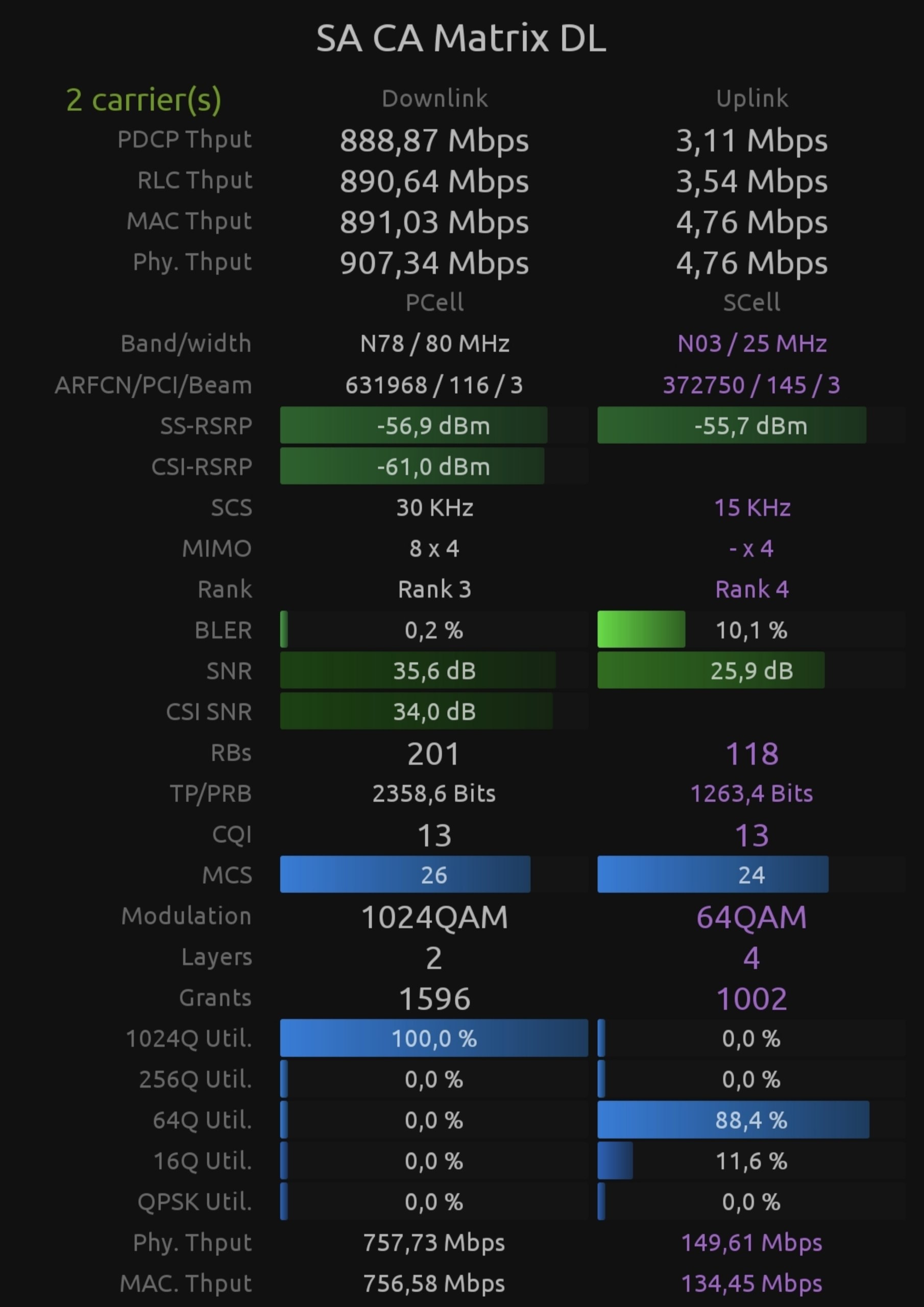
That is roughly a 25 percent capacity improvement compared to what the same two layers would deliver with 256QAM. And it is worth pointing out that this is only half of what the configuration could do. If you calculate the same modulation across 4 streams, the maximum throughput would double to around 1.5 Gbps PHY. The limitation here comes from the radio environment, not from the modulation itself.
Non line of sight is a different story
In a non line of sight scenario it was much harder to achieve a high usage percentage of 1024QAM. With reflections and fading in the path, the SNR drops and the handset falls back to 256QAM for a good part of the time.
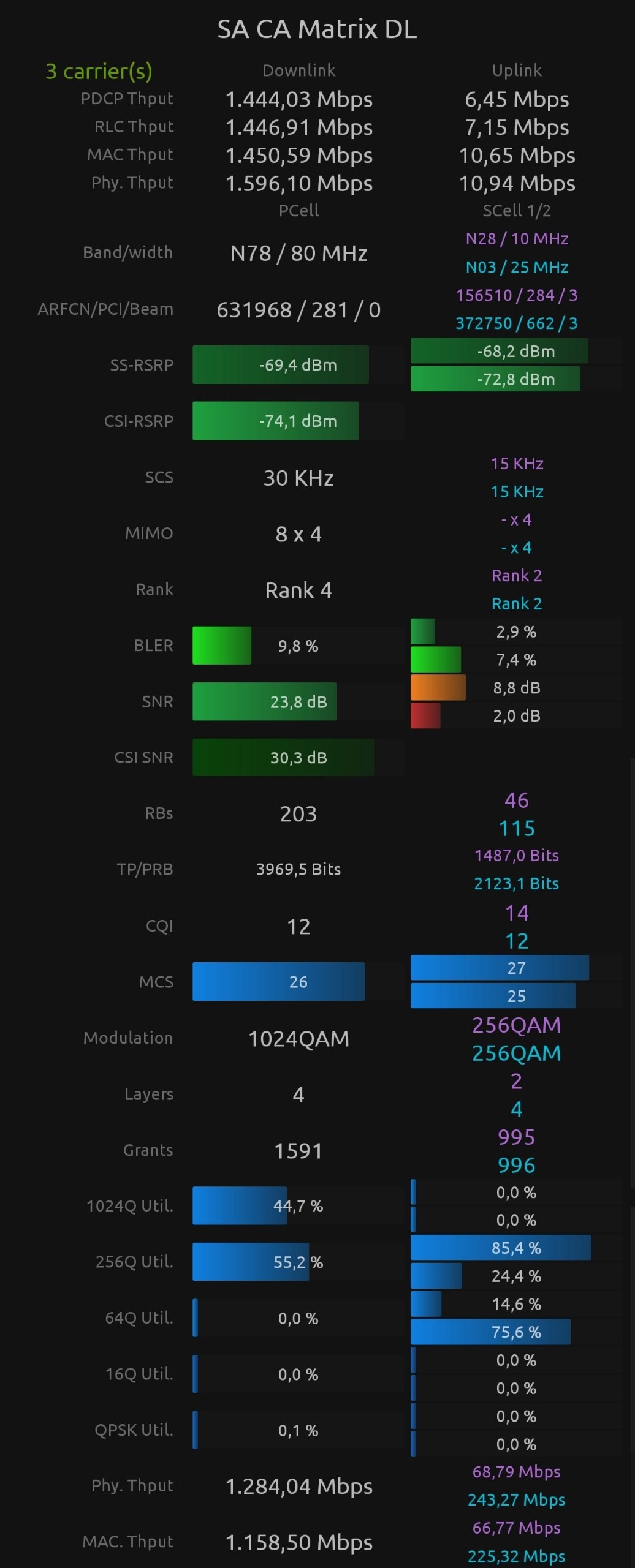
That said, it was still mostly possible to use around 50 percent 1024QAM in good conditions close to the site. In those spots the extra modulation gave roughly a 5 to 10 percent improvement in downlink capacity and throughput. The spot in the screenshot below is a good example of how the two effects trade off. It only reaches around 45 percent 1024QAM utilisation, but the handset was able to use 4 layers and three carriers, so the overall throughput ends up well above the line of sight case.
What this means in practice
The interesting part of this test is not really the peak number. It is that 1024QAM behaves exactly as theory predicts. It gives a solid capacity gain when the radio conditions are good enough to support it, and it quietly steps aside when they are not. That is the whole point of adaptive modulation, and seeing it work on a live commercial network is a good reminder of how much flexibility there is in the 5G NR downlink.
It is also worth pointing out that 1024QAM is not some exotic hardware feature. The modem in devices like the Xiaomi 17 Ultra already supports it, it is just not enabled by the manufacturer or by the operator yet. So this is less about new hardware and more about when the feature gets switched on. Tests like this show what the network and the devices are already capable of.