Back in May I wrote about Vodafone Germany’s first uplink TX switching rollout on their 5G standalone network. That was the Release 16 version, and it combined NR uplink carrier aggregation with uplink MIMO to push upload throughput higher. Vodafone is now rolling out the Release 17 version of the same feature, and it adds one notable capability.
What is new in Release 17
Release 17 uplink TX switching is not a new mechanism. It works the same way as Release 16. The difference is on the FDD side.
With Release 16, the FDD carrier only ever carried a single uplink layer. While the TDD carrier was busy with downlink slots, the handset used one of its two transmit antennas to send a single stream on the FDD carrier. Once the TDD carrier switched to uplink slots, both antennas moved over to the TDD carrier and used spatial multiplexing to send two streams.
Release 17 removes that limitation. The FDD carrier can now also use spatial multiplexing and carry two uplink data streams, so both carriers in a switched uplink configuration can run two layers. In practice this means the upload stays on two layers no matter which carrier the antennas are currently pointing at, which lifts throughput during the FDD phases of the frame.
The comparison below comes from MediaTek’s R17 5G NR uplink transmit switching whitepaper.
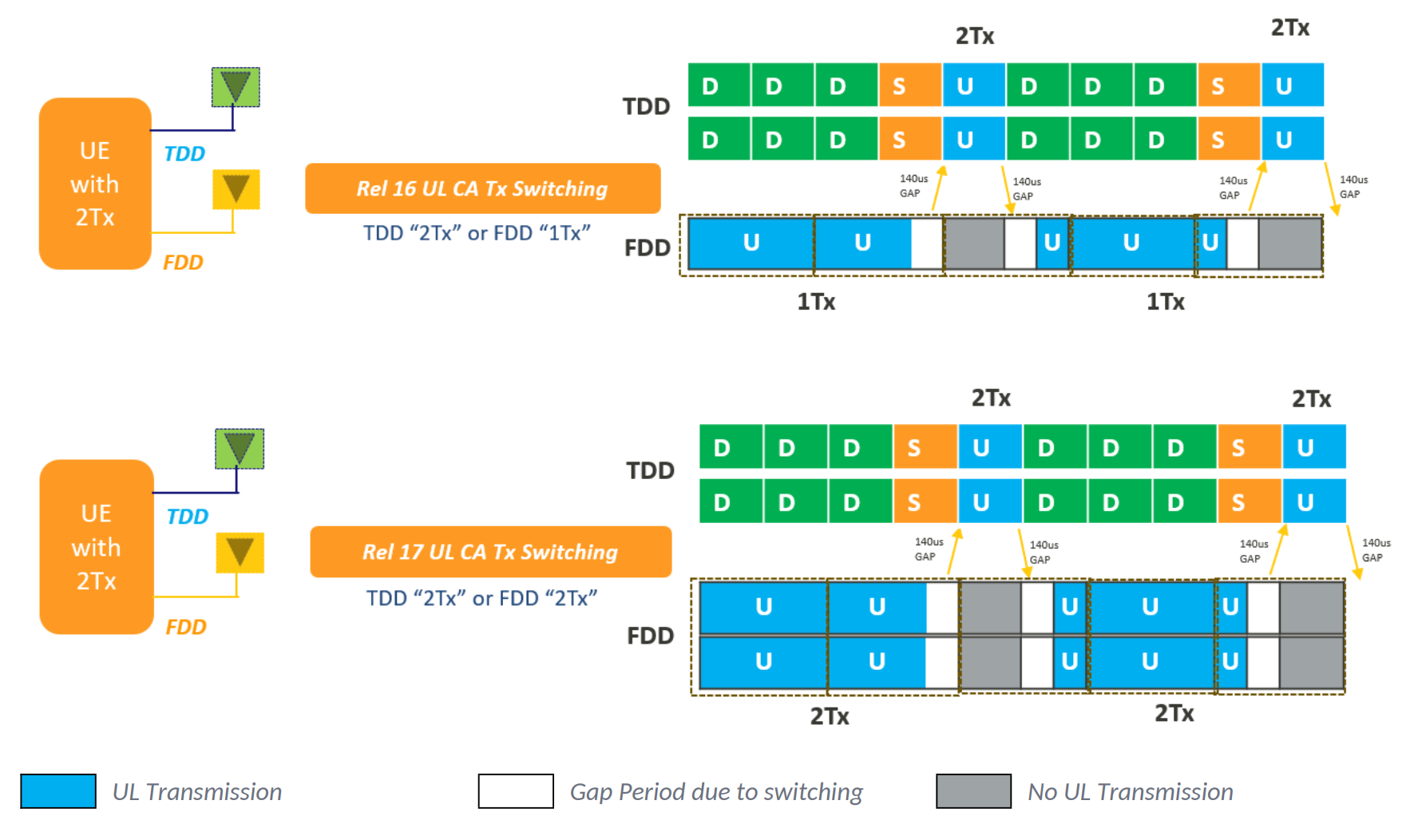
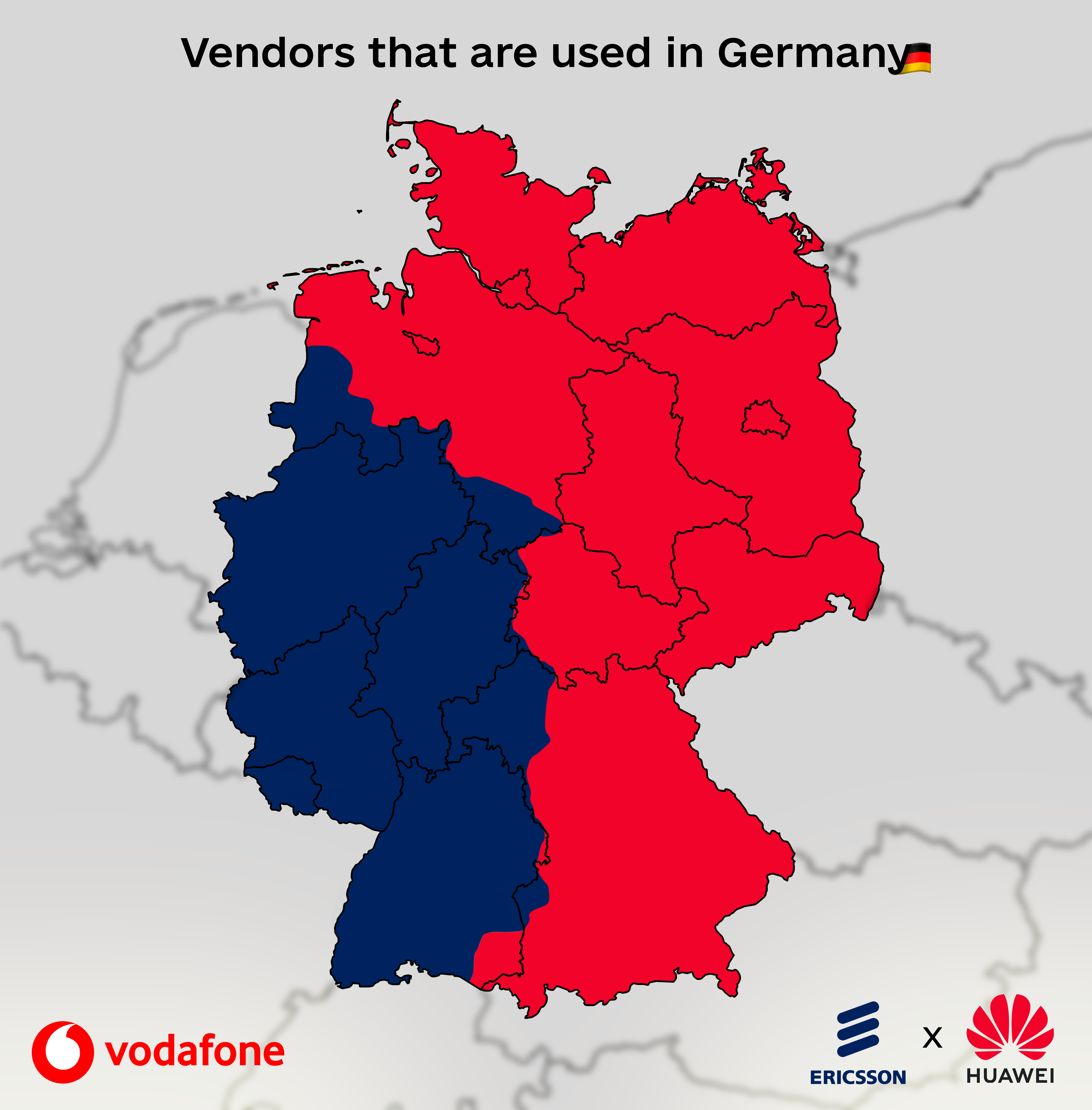
One thing worth repeating from the first post, because it still applies. In the Ericsson vendor region, only TDD as PCell is supported to take advantage of uplink TX switching. The feature is not available with an FDD carrier as PCell. This is unchanged in Release 17. Thanks to Roman for the great graphic!
Choosing between 14 uplink configurations
Because uplink TX switching now has to coexist with the other uplink features, Vodafone’s network has to decide between 14 distinct uplink configurations for the three 5G bands it uses, which are N78 (TDD, 3.5 GHz), N28 (FDD, 700 MHz) and N3 (FDD, 1.8 GHz). The table below lists them. This only applies to handsets that actually support the respective feature.
| Uplink configuration | Band combination | PCell | SCell | Uplink layers |
|---|---|---|---|---|
| Single band SISO | N78 | N78 | - | 1 |
| Single band SISO | N28 | N28 | - | 1 |
| Single band SISO | N3 | N3 | - | 1 |
| Single band UL MIMO | N78 | N78 | - | 2 (spatial multiplexing) |
| Single band UL MIMO | N3 | N3 | - | 2 (spatial multiplexing) |
| NR UL-CA | N78 + N28 | N78 | N28 | 2, one per carrier |
| NR UL-CA | N78 + N3 | N78 | N3 | 2, one per carrier |
| NR UL-CA | N28 + N3 | N28 | N3 | 2, one per carrier |
| NR UL-CA (swapped) | N78 + N28 | N28 | N78 | 2, one per carrier |
| NR UL-CA (swapped) | N78 + N3 | N3 | N78 | 2, one per carrier |
| NR UL-CA (swapped) | N28 + N3 | N3 | N28 | 2, one per carrier |
| R16 UL Tx switching | N78 + N28 | N78 | N28 | 2, FDD side limited to 1 layer |
| R16 UL Tx switching | N78 + N3 | N78 | N3 | 2, FDD side limited to 1 layer |
| R17 UL Tx switching | N78 + N3 | N78 | N3 | 2, either carrier can use SMDL |
That gives three single band SISO configurations, two single band UL MIMO configurations, six NR UL-CA configurations, two Release 16 switched uplink configurations and one Release 17 switched uplink configuration.
The two single band UL MIMO entries are only there for N78 and N3. Low band SMDL is still rarely seen on any mobile device, so a single band N28 uplink MIMO configuration is not something you will find in practice today. The six NR UL-CA entries cover N78 and N28, N78 and N3, and N28 and N3, each once with the TDD or low band carrier as PCell and once with the carriers swapped.
Rollout details
The Release 17 switched uplink feature is currently only rolled out on stations that have at least third generation baseband hardware, meaning Baseband 6631 and above. The older Baseband 6630 is too old for it. The same hardware requirement applies to the related NR FDD UL SU-MIMO feature. This is also why the rollout is limited to sites with TDD cells for now, because in most cases they feature newer and supported baseband hardware. FDD only sites that run just N28 or N3, or both are left out for now, which also means there is no FDD UL MIMO on those sites.
The highest L2 throughput I have seen measured so far is around 300 Mbps combined, on a Xiaomi 17 Ultra that natively supports the feature in Vodafone’s 5G SA network, under good conditions. That number will depend heavily on the radio environment and on how much of the resources the handset gets assigned on the FDD carrier.
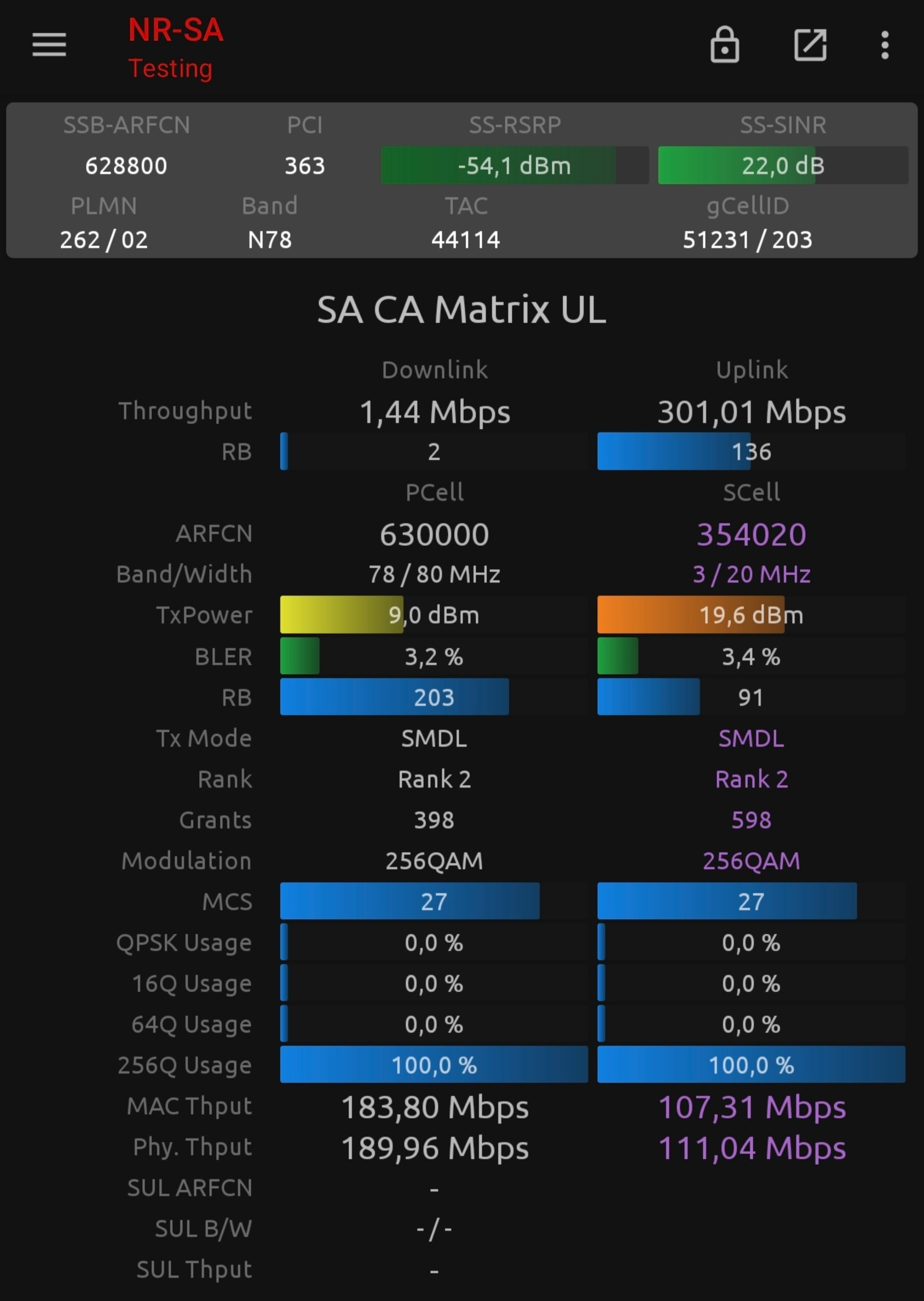
What stands out to me is how the handset handles weaker conditions. When the radio link gets worse, the device can fall back from SMDL to SMSL on the fly, so the uplink always runs with the number of layers that the current conditions can support.
Taken together, this rollout is another example of Vodafone Germany sitting on the bleeding edge of 5G features. They are clearly willing to try things out before they become mainstream and supported across a broad range of mobile devices, and this one is no exception.